Best Trimmer Guide: How to Pick One Without Wasting Money (2026)

I once bought a trimmer for ₹399 because it had 4.2 stars and “10000+ bought in past month” stamped under it. It died in six weeks. The blades went blunt, the battery stopped holding charge past 15 minutes, and I was back on Amazon reading the same reviews I’d ignored the first time.
That’s the trap most beginners fall into. You’re not short on options — you’re short on a way to tell a genuinely good ₹500 trimmer from a genuinely bad one wearing the same plastic shell. This guide fixes that. No spec-sheet jargon, no brand worship, just what actually matters when the blade hits your skin.
Why Picking the Right Trimmer Actually Matters
A trimmer touches your face or body almost every day. A bad one doesn’t just give a patchy trim — it tugs hair instead of cutting it, heats up mid-session, and leaves your skin red for an hour afterward. Over a year, a cheap trimmer that needs replacing every four months can cost you more than one solid mid-range trimmer that lasts three years. This isn’t a “buy the expensive one” argument. It’s a “know what you’re paying for” one.
What Is a Trimmer? (Quick Definition)
A trimmer is a battery-powered or corded grooming device with oscillating blades that cut hair to a set length, rather than removing it from the root. Unlike a razor, it doesn’t touch the skin directly — guard combs control the cutting length, which makes it faster and gentler for everyday beard, hair, or body grooming.
Types of Trimmers: Know Before You Buy
- Beard/Stubble Trimmers – Built for facial hair, usually 0.5mm to 20mm length range
- Body Groomers – Wider blades, designed for chest, back, and underarm hair (avoid for the face)
- Multi-grooming Kits – One motor body, swappable heads for beard, nose, ears, and body
- Hair Clippers – Higher torque motors for full head haircuts, not interchangeable with beard trimmers
- Bikini/Intimate Trimmers (for women) – Smaller heads, rounded tips, designed for sensitive skin
Pro Tip (Information Gain)
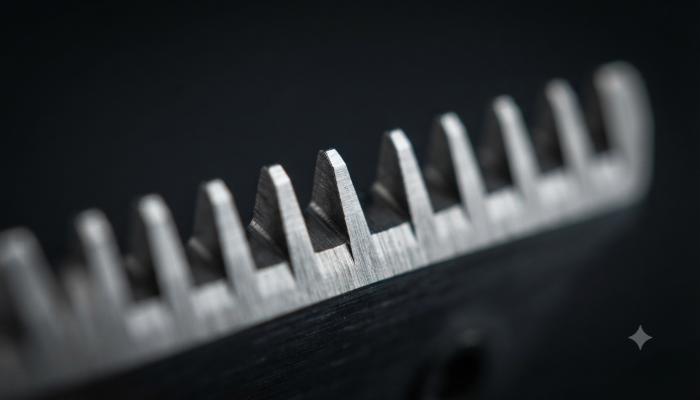
Here’s something most buying guides skip: check the blade gap, not just the brand. A wider blade gap (the space between teeth) handles thick, curly hair without snagging, while a tighter gap is better for fine, straight hair. Indian hair tends to be coarser on average, which is exactly why brands like Havells market “Capture Trim” wide-blade tech specifically for the Indian market— extra-wide blades that capture more hair in one stroke, reducing your time in front of the mirror. If a listing doesn’t mention blade width or gap at all, that’s usually a sign the spec wasn’t a design priority.
Best Trimmer for Men: What to Actually Look For
For men, three things separate a good trimmer from a forgettable one:
- Battery runtime vs. charge time — A 90-minute runtime on a 1-hour charge beats a 120-minute runtime that needs 8 hours to top up
- Blade material — Titanium-coated, self-sharpening steel blades stay sharp longer and need less oiling than basic stainless steel
- Precision settings — Look for at least 10-20 length settings via a dial, not just snap-on combs
Common Pitfall
Don’t buy based on “number of attachments” alone. I’ve seen 15-in-1 kits where ten of the attachments are essentially the same comb in slightly different plastic. Count the actually useful heads — beard, body, nose/ear — not the marketing number.
Also Read: Best Gaming Mouse for Beginners: The Only Guide You Need in 2026
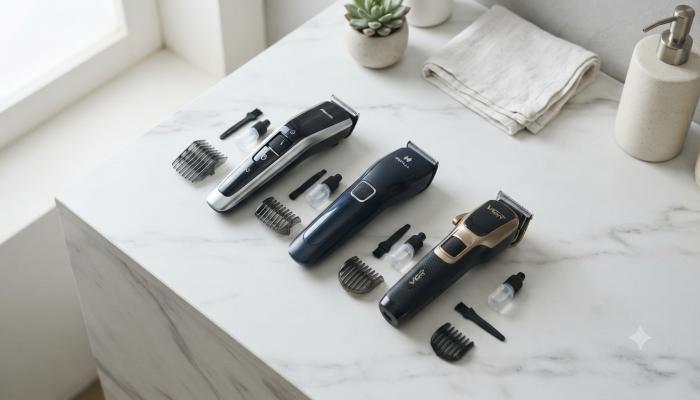
Trimmer Philips vs Havells vs VGR: A Real Comparison
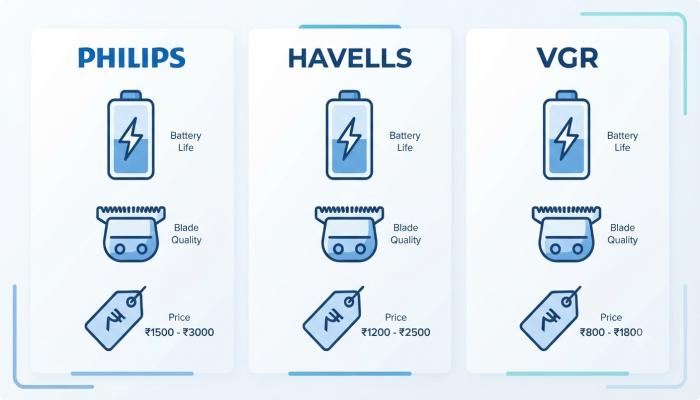
This is where most beginners get stuck. Here’s how the three most-searched brands actually stack up, based on what they’re each genuinely good at.
| Feature | Philips | Havells | VGR |
|---|---|---|---|
| Price Range | ₹700 – ₹3,500+ | ₹500 – ₹2,000 | ₹400 – ₹1,200 |
| Blade Quality | Titanium, self-sharpening, rounded tips | Wide stainless steel, good for thick hair | Decent steel, sharpens needed sooner |
| Battery | 60–90 min typical | Up to 120 min on select models | 90–150 min on select models |
| Service Network | Widest in India | Strong in Tier 2/3 cities | Limited, mostly online support |
| Best For | Skin-sensitive users, long-term reliability | Budget buyers wanting Indian-hair-tuned blades | Tight budget, barbershop-style metallic look |
Philips’ beard trimmer lineup is widely compared and reviewed online for fit-to-need. If you’re a beginner with no strong brand loyalty, Philips is the safer default purely because of after-sales service — if a part fails, you’re not stuck searching for an obscure replacement.
Pro Tips / Common Pitfalls Box
- Don’t trim immediately after a shower — wet hair clumps and clogs blades faster than dry hair
- Oil the blades monthly, even if the box doesn’t remind you — a drop of trimmer oil prevents the heating issue that kills motors early
- Never fully submerge a trimmer body in water, even if the head is washable — only IPX7-rated full-body models are shower-safe
Trimmer for Women: What’s Different
Women’s trimmers aren’t just “men’s trimmers in a different color.” Board-certified dermatologists point out that trimmers are a genuinely good option for the bikini area because there’s less risk of irritation compared to waxing or epilating, and they help prevent razor burn. The design priorities shift:
- Rounded, skin-stretching tips instead of flat blade edges
- Lower vibration motors for use on thinner, more sensitive skin
- Smaller trim heads for precision around curves and folds
- Hypoallergenic blade coatings (ceramic or stainless steel) to reduce redness
If you’re buying your first trimmer for intimate or facial hair grooming as a woman, prioritize a model explicitly marketed for “lady” or “bikini” use rather than adapting a beard trimmer — the blade angle and guard depth are genuinely engineered differently.
How to Choose a Trimmer Under ₹500
Yes, a genuinely usable trimmer exists under ₹500 — but go in with calibrated expectations.
Step-by-step approach:
- Check the warranty first — anything under ₹500 with less than 6 months warranty is a red flag
- Read the 1-star and 2-star reviews specifically — 5-star reviews on day-one purchases don’t tell you about month-three battery degradation
- Confirm it’s USB Type-C if possible — proprietary charging cables become useless the moment you lose them
- Avoid “corded only” models unless you genuinely don’t mind being tethered near a socket
- Check return window — budget electronics have higher defect rates; you want at least 7-10 days to test it
At this price point, treat the trimmer as a 6-12 month tool, not a 3-year investment. That’s not a failure — that’s the honest math of the budget tier.
Also Read: OTT Apps in India: The Beginner’s Guide to Choosing, Downloading, and Actually Using Them
Trimmer for Men Philips: Picking Within the Brand
Philips alone has 6-7 active trimmer lines, which confuses beginners more than it should. As a rule of thumb:
- 3000 series = entry-level, solid for daily stubble maintenance
- 5000 series = added precision dial, better for styled beards
- 7000+ series / Multigroom kits = full body + face + nose coverage in one device
If you only need beard maintenance, don’t overpay for a multigroom kit you’ll use 20% of. Match the series to your actual grooming routine, not the longest feature list.
Visual Asset Strategy
Comparison Table Visual
Pro Tip / Blade Close-up
Semantic FAQ
1. Which trimmer is best for beginners?
A trimmer with adjustable length settings (10+), a washable head, and at least a 6-month warranty is ideal for beginners — Philips 3000 series or Havells BT-series models fit this without overwhelming you with features.
2. Is Havells trimmer better than Philips?
Havells trimmers are generally better value for thick, coarse hair at a lower price point, backed by one of the best service networks in India, while Philips wins on blade longevity and overall build refinement.
3. Can I use a men’s trimmer for body grooming?
Only if it’s labeled as a body groomer or multigroom kit — standard beard trimmer blades are too narrow-toothed and can be uncomfortable on larger skin areas like the chest or back.
4. How often should I oil my trimmer blades?
Once a month with a drop of the lubricating oil that usually comes in the box — this is one of the most skipped maintenance steps and the most common reason trimmers die early.
5. Is a trimmer under ₹500 worth buying?
Yes, for short-term or occasional use, but expect a 6-12 month lifespan rather than multi-year durability — check the warranty and recent reviews before buying.
6. What’s the difference between a trimmer and a shaver?
A trimmer cuts hair to a set length above the skin using guarded blades, while a shaver cuts hair at skin level for a closer, razor-like finish — trimmers are gentler and better for daily maintenance.
7. Are VGR trimmers good for everyday use?
VGR trimmers are solid for budget daily use and have a barbershop-style metallic build, but blades tend to dull faster than Philips or Havells, so factor in earlier sharpening or replacement.
Your Next Step: A 5-Point Checklist Before You Buy
Don’t close this tab and go straight to “Buy Now.” Run through this first:
- [ ] Confirmed blade material (titanium > stainless steel for longevity)
- [ ] Checked battery runtime AND charge time, not just one of them
- [ ] Read the warranty period — minimum 1 year if budget allows
- [ ] Matched the trimmer type to your actual need (beard ≠ body ≠ bikini)
- [ ] Scanned 1-2 star reviews for recurring complaints, not just the star average