Best Powerbank Deals Right Now — What Actually Matters Before You Buy

Your phone dies at 18% in the middle of something important. You’ve been there. And you probably told yourself you’d grab a power bank “sometime soon.” If that’s still on your list, this guide cuts straight to what you need to know — no jargon, no fluff — so you can pick the right one and stop worrying about battery anxiety forever.
What Is a Power Bank, and How Do You Read the Numbers?
A power bank is a portable battery pack that stores electrical charge and transfers it to your device via USB. Capacity is measured in milliampere-hours (mAh). A 10000mAh bank can roughly charge a 4000mAh smartphone battery about 1.8–2 times, accounting for conversion loss.
Key specs at a glance:
- mAh (capacity): How much charge it holds
- Output wattage: How fast it charges your device
- Input wattage: How quickly the bank itself recharges
- Number of ports: How many devices at once
- Weight: What you’re carrying in your pocket or bag
📌 Pro-Tip most guides skip: The “real-world capacity” of any power bank is roughly 60–70% of the rated mAh. A 20000mAh bank typically delivers 12,000–14,000mAh due to voltage conversion loss and heat. Factor this in before buying.
Why Powerbank Deals Matter More Than Just the Lowest Price
I’ve seen people buy the cheapest option available and end up with a bank that takes 10 hours to recharge itself, uses outdated micro-USB input, and barely pushes out 1A — meaning it charges your phone at the same speed as an old wall adapter from 2012.
Price matters, but the right specs at a fair price is what you’re actually after. Here’s a quick sanity check:
- Under ₹300: Expect 5000–10000mAh, basic charging (5W), micro-USB input. Functional, not fast.
- Under ₹500: The sweet spot. You can find genuine 10000mAh banks with USB-C input and 12–18W output from brands like Ambrane, Syska, and Mi.
- ₹800–₹1500: 20000mAh, fast charging (22W+), dual output ports. Great for travelers and heavy users.
Also Read: Smart TV Buying Guide: How to Pick the Right One Without the Headache
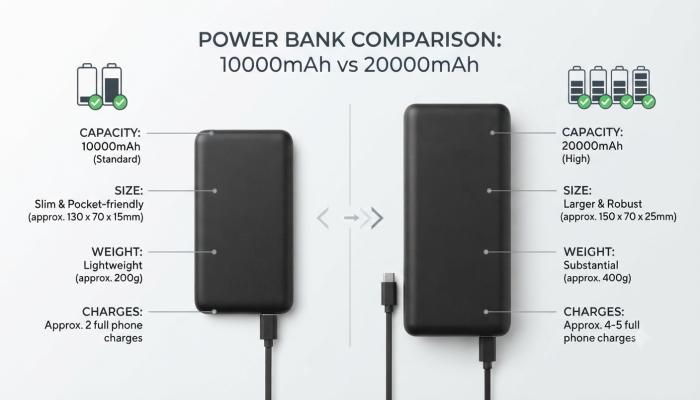
Power Bank 10000mAh vs 20000mAh — Which Should You Buy?
This is the most common question, and the answer depends on one thing: how and where you use your phone.
| Feature | 10000mAh | 20000mAh |
|---|---|---|
| Avg. charges (4000mAh phone) | ~1.8–2x | ~3.5–4x |
| Weight | 180–220g | 320–420g |
| Size | Pocket-friendly | Small bag needed |
| Price range (India) | ₹400–₹800 | ₹900–₹1800 |
| Best for | Daily commuters | Travelers, heavy users |
| TSA/Flight safe | ✅ Yes (under 100Wh) | ✅ Yes (under 100Wh) |
My take: If you mostly charge once a day during commutes, a 10000mAh is all you need. If you travel overnight or use mobile data heavily (gaming, navigation, streaming), go for 20000mAh.
Best Power Bank in India: Brands Worth Trusting
Not every brand on Amazon or Flipkart is worth your money. Here’s a no-nonsense breakdown:
Reliable Brands (tested, trusted, widely available):
- Mi (Xiaomi): Consistent build quality, accurate capacity ratings, widely available service centers. Their 10000mAh with 22.5W fast charge is one of the best power bank deals under ₹800.
- Ambrane: India-born brand, good value, solid warranty support.
- Syska: Decent mid-range pick with ISI-certified units.
- Anker: Premium pricing, but charging tech (PowerIQ, MultiProtect) is genuinely top-tier.
- boAt: Trendy and affordable, though some budget models underperform on actual mAh delivery.
Avoid: Generic no-brand banks from obscure sellers, especially on resale marketplaces. They routinely misrepresent capacity — some “20000mAh” units measured at under 8000mAh in independent tests.
⚠️ Common Pitfall: Checking only star ratings without reading written reviews. A product can have 4.2 stars with hundreds of “fast delivery” reviews buried under a few critical ones flagging swelling, overheating, or capacity fraud.
How to Find the Best Powerbank Deals on Amazon
Amazon is the biggest marketplace for powerbank deals in India, but the discounts can be misleading. Here’s a smarter buying approach:
Step 1: Set your actual need first. Decide on capacity (10000 or 20000mAh), charging speed, and budget before browsing. Filters help but can show “on sale” items that were never worth full price.
Step 2: Use price tracking tools. Prices on Amazon fluctuate often. Tools like Keepa or CamelCamelCamel show historical pricing — so you know if that “40% off” is real or manufactured.
Step 3: Filter for “Amazon’s Choice” or “ISI Certified.” In India, BIS (Bureau of Indian Standards) certification is a minimum quality signal. For electronics, always check if the seller is brand-authorized.
Step 4: Check seller ratings. Third-party sellers with under 90% positive ratings and no return policy should be skipped entirely.
Step 5: Read the Q&A section. This is underused gold. Buyers directly ask brands questions like “Does this support fast charging for Samsung?” — and the answers are often more honest than the product description.
Also Read: Best Gaming Mouse for Beginners: The Only Guide You Need in 2026
Visual Asset Strategy
Price tier chart

Semantic FAQ (People Also Ask)
Q: Which power bank is best under ₹500 in India?
Look for 10000mAh options from Mi, Ambrane, or Syska with USB-C input and at least 12W output. Mi’s Lite series and Ambrane’s 10000mAh units frequently hit this price during sales.
Q: Is a 20000mAh power bank allowed on flights?
Yes — 20000mAh at 3.7V equals approximately 74Wh, well under the 100Wh airline limit. But always carry it in your hand luggage, never checked baggage, per DGCA and IATA rules.
Q: How long does a 10000mAh power bank take to charge itself?
Depends on input wattage. With a 10W charger and USB-C input, expect 3–4 hours. With an old 5W micro-USB input, you’re looking at 6–8 hours. Always check the bank’s input spec, not just the output.
Q: What does mAh actually mean for a power bank?
mAh stands for milliampere-hour — the total charge a battery stores. Higher mAh = more charges, but due to conversion loss during output, you get roughly 60–70% of the rated capacity in real use.
Q: Is fast charging safe for my phone battery?
Yes, when done with a certified bank and compatible cable. Brands using Qualcomm Quick Charge or USB Power Delivery (PD) protocols have built-in thermal protection and negotiate voltage levels with your phone’s charging IC to prevent damage.
Q: Which is better — 10000mAh or 20000mAh for daily use?
For a single device and everyday commuting, 10000mAh is lighter and easier to carry. For travel, two devices, or heavy streaming days, 20000mAh is worth the extra weight.
Q: Are cheap power banks under ₹300 safe?
Some are fine for occasional use, but many lack proper circuit protection (overcharge cutoff, short circuit protection). Stick to known brands even at the lowest price tier and verify BIS certification.
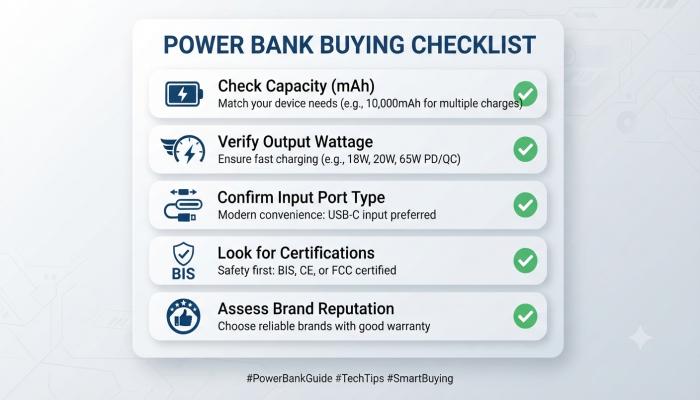
Your Next Step Checklist — Don’t Close This Page Without Doing This
You’ve read the specs, you know the brands, and you understand the price tiers. Here’s exactly what to do next:
- [ ] Decide your capacity need: 10000mAh (daily use) or 20000mAh (travel/power user)
- [ ] Set your budget: Under ₹500, ₹800, or ₹1500?
- [ ] Check that the bank has USB-C input (not micro-USB — that’s dated tech)
- [ ] Confirm at least 18W output if you want fast charging
- [ ] Verify the listing shows BIS certification or ISI mark
- [ ] Cross-check price history using Keepa before buying
- [ ] Read at least 10 written reviews (not just ratings) for the specific model