Best Camera Phone in 2026: A Beginner’s No-Nonsense Guide

Introduction
You don’t need a ₹1,00,000 phone to take stunning photos. But you do need to know which specs actually matter — and which ones manufacturers just use to pad the box.
I’ve watched dozens of beginners overspend on phones with impressive-sounding 200MP cameras, only to get blurry, washed-out shots in low light. Why? Because megapixels are only one piece of the puzzle.
This guide cuts through the noise. Whether you’re looking for the best camera phone under ₹15,000, a 5G best camera phone, or simply want to know the top 10 best camera phones in the world right now — you’ll find a straight answer here.
Why the Camera Has Become the Most Important Feature in a Phone
Three years ago, people bought phones for battery life. Now? It’s almost always the camera.
Here’s why it matters more than ever:
- Social media is visual. Instagram Reels, YouTube Shorts, and WhatsApp Status have made video quality a daily need, not a luxury.
- Replacing a dedicated camera. Most beginners don’t carry a DSLR. Your phone IS your camera.
- Memories don’t have second chances. A bad shot of your child’s first steps can’t be retaken. A good phone camera gives you that shot, reliably.
The camera arms race between brands like Samsung, Apple, Google, and OnePlus has genuinely benefited everyday users — even phones under ₹20,000 now shoot impressive results.
What Actually Makes a Phone Camera “The Best”?
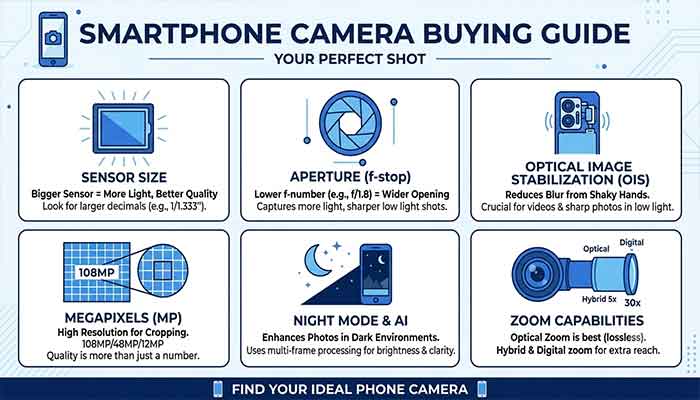
Quick Answer: A great smartphone camera depends on five core factors — sensor size, aperture width, optical image stabilization (OIS), computational photography software, and low-light (night mode) performance. Megapixel count alone does not determine photo quality.
Let’s break each one down simply:
Sensor Size — The One Spec Beginners Always Ignore
Bigger sensor = more light captured = better photos. It’s that simple.
A phone with a 1/1.3-inch sensor and 50MP will almost always outperform a phone with a 1/2.8-inch sensor at 108MP. Samsung’s marketing loves big megapixel numbers. Google’s Pixel phones love big sensors. Guess which ones win in real-world testing?
Aperture — How Wide the “Eye” Opens
Aperture is written as f/1.8, f/2.0, etc. Lower number = wider opening = more light. For beginners shooting indoors or at night, aim for f/1.8 or lower.
OIS (Optical Image Stabilization)
This is a physical mechanism inside the lens that counters hand shake. It’s the difference between a blurry birthday party video and a smooth, watchable one. Non-negotiable if you shoot video.
Computational Photography (AI Processing)
This is where Google Pixel phones consistently win. The software “thinks” about how to process the image — sharpening edges, reducing noise, balancing exposure — all in milliseconds. Great hardware with bad software produces mediocre results.
Night Mode / Low-Light Performance
Real test: take 5 photos in a dim restaurant without flash. The phone that gives you usable, clear images wins. This is where cheap phones fail the hardest.
Also Read: teckjbcom
World Best Camera Phone List: Top 10 Picks for 2026
| Rank | Phone | Best For | Approx. Price (India) |
|---|---|---|---|
| 1 | Samsung Galaxy S25 Ultra | All-around flagship | ₹1,29,999 |
| 2 | Apple iPhone 16 Pro Max | Video & color accuracy | ₹1,34,900 |
| 3 | Google Pixel 9 Pro | Night shots & AI editing | ₹1,09,999 |
| 4 | OnePlus 13 | Flagship killer camera | ₹69,999 |
| 5 | Samsung Galaxy S25+ | 5G + great camera | ₹79,999 |
| 6 | Vivo X200 Pro | Zoom photography | ₹74,999 |
| 7 | iQOO 13 | Camera + gaming balance | ₹54,999 |
| 8 | Samsung Galaxy A56 | Best camera phone under ₹30,000 | ₹29,999 |
| 9 | Redmi Note 14 Pro+ | Best camera phone under ₹20,000 | ₹19,999 |
| 10 | Moto G85 | Best camera phone under ₹15,000 | ₹14,999 |
Prices are approximate at time of writing and may vary by retailer.
Best Camera Phone Under ₹15,000: Real Options That Work
Budget doesn’t mean bad — it means knowing what to trade off.
At this price point, you’re giving up telephoto zoom and ultra-fast video. What you can still get: a decent wide-angle shooter, passable night mode, and solid daylight performance.
Top Pick: Moto G85
- 50MP f/1.8 Sony sensor
- OIS included (rare at this price)
- Clean, uncluttered software
Honest Trade-off: The selfie camera is average. Portrait mode is hit-or-miss. But for outdoor, daytime photos? It punches above its class.
⚠️ Common Pitfall: Phones at this price range often advertise “AI camera” features. These are mostly software filters, not real computational photography. Lower your expectations for night shots and indoor candids.
Best Camera Phone Under ₹20,000: Where Value Peaks
This is the sweet spot for most users in India. The jump in quality from ₹15K to ₹20K is significant.
Top Pick: Redmi Note 14 Pro+
- 200MP main sensor (here, it actually helps — Xiaomi’s pixel-binning is smart)
- Leica-tuned color processing
- 4K video recording
Pro-Tip 🔑: If you care about video, test the phone in a store with fluorescent lighting (like a mall). Flicker and colour cast under artificial light is where cheap video processing breaks down. Most reviewers don’t test this.
Best Camera Phone Under ₹30,000: 5G and Great Cameras Together
The Samsung Galaxy A56 is the recommendation I give most confidently to friends and family. It’s not the most exciting phone on paper, but it’s reliable, well-supported with software updates, and the camera rarely embarrasses you.
For 5G capability + great camera in one package at this budget, also consider:
- Nothing Phone (3a) Pro — distinctive design, solid camera
- OnePlus Nord CE4 — excellent video quality for the price
Best Camera Phone in India: Flagship Tier (₹50,000+)
If you can invest in a flagship, the OnePlus 13 is the best camera phone in India for most people who don’t want to spend Apple or Samsung premium prices.
It uses a Hasselblad-tuned camera system with large sensors, natural colour science, and excellent 4K 60fps video. Real-world results are on par with phones costing ₹30,000 more.
For absolute camera crown: the Samsung Galaxy S25 Ultra remains the world’s best camera phone for most photographers. The 200MP sensor combined with intelligent pixel-binning, a dedicated telephoto, and Samsung’s ProVisual Engine produces results that were unthinkable from a phone three years ago.
⚠️ Pro-Tips Box: 5 Mistakes Beginners Make When Buying a Camera Phone
- Chasing megapixels. A 200MP phone with a tiny sensor takes worse photos than a 50MP phone with a large one.
- Ignoring software updates. Camera quality improves with updates. A phone abandoned by its maker gets worse over time.
- Skipping OIS. If you shoot video at all, this is non-negotiable.
- Trusting sample photos on retail websites. These are taken by professional photographers with optimal lighting. Always find real-user samples on Reddit or YouTube.
- Not testing the front camera. If you take selfies or do video calls, spend 60 seconds testing the front camera in the store.

FAQ: People Also Ask About the Best Camera Phone
Q1. Which is the No. 1 camera phone in the world right now?
As of 2026, the Samsung Galaxy S25 Ultra and Apple iPhone 16 Pro Max share the top position depending on your priorities. The S25 Ultra wins for zoom and versatility; the iPhone wins for video and colour consistency.
Q2. Which is the best camera phone under ₹15,000 in India?
The Moto G85 is currently the strongest option — it includes OIS (rare at this price), a Sony sensor, and consistent software. Honourable mention to the Redmi 13C for selfie quality.
Q3. Does more megapixels mean a better camera?
No. Sensor size, aperture, and image processing software matter far more. A 50MP phone with a large sensor outperforms a 200MP phone with a tiny one in most real-world situations.
Q4. Is a 5G phone better for camera quality?
Not directly — 5G is a connectivity feature, not a camera feature. However, newer 5G phones tend to also have more advanced camera hardware because they are newer models.
Q5. What is the best camera phone for videos?
For video, the Apple iPhone 16 Pro Max (best for cinematic 4K), OnePlus 13 (best value), and Google Pixel 9 Pro (best stabilization) are the top choices.
Your Next Step: A Simple Buying Checklist ✅
Don’t leave this article and immediately order the most expensive phone you can afford. Instead, do this:
- [ ] Define your main use case — travel, portraits, video, or everyday snaps?
- [ ] Set your real budget — include a case and screen protector in your mental budget
- [ ] Shortlist 2-3 phones from the table above that fit your price range
- [ ] Watch 2 YouTube reviews for each shortlisted phone — look for low-light and indoor test footage
- [ ] Check the update policy — does the brand commit to 3+ years of software updates?
- [ ] Test in-store if possible — take 5 photos in the store’s lighting conditions before buying
The best camera phone isn’t the one with the best spec sheet. It’s the one that fits your life, your budget, and your hands — and that you’ll actually carry everywhere.